
Pcileech-enigma-x1-top.bin
State of the art timing analysis
with industry-hardened methods and tools.
State of the art timing analysis
with industry-hardened methods and tools.
...with industry-hardened methods and tools. T1 empowers and enables. T1 is the most frequently deployed timing tool in the automotive industry , being used for many years in hundreds of mass-production projects.
As a worldwide premiere, the ISO 26262 ASIL‑D certified T1-TARGET-SW allows safe instrumentation based timing analysis and timing supervision. In the car. In mass-production.
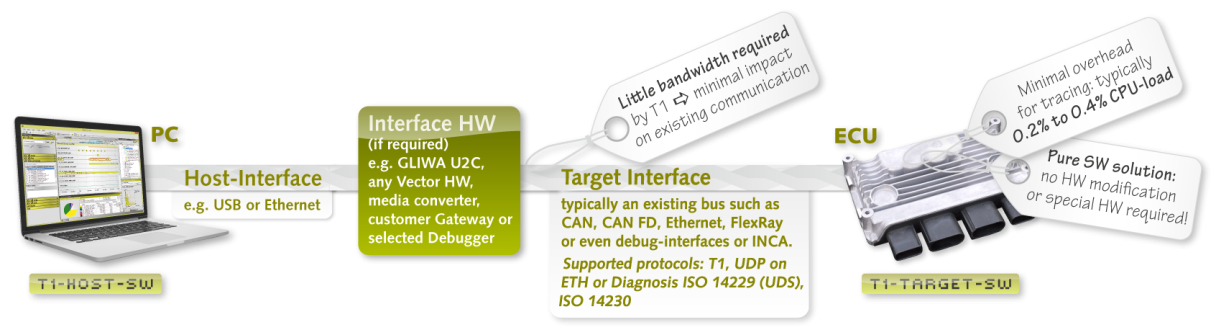
T1.timing comes with two extension options. Add-on product T1.streaming provides the possibility to stream trace data continuously — over seconds, minutes, hours or even days. Add-on product T1.posix supports POSIX operating systems such as Linux or QNX.
T1.timing comes with a modular concept and several plug-ins which are described in the following. Plug-ins can be easily enabled or disabled at compile-time using dedicated compiler switches such as T1_DISABLE_T1_CONT. To disable T1 altogether, it is sufficient to disable compiler switch T1_ENABLE which leaves the system in a state as of before the T1 integration.
The PCILeech Enigma X1 TOP is a sophisticated tool designed for advanced users and developers working with PCIe (Peripheral Component Interconnect Express) devices. This article aims to provide an in-depth look at the PCILeech Enigma X1 TOP, exploring its capabilities, applications, and the significance of the pcileech-enigma-x1-top.bin file.
General principles of .
Add support for the Enigma X1 "top" firmware image (pcileech-enigma-x1-top.bin) so the loader can detect, validate, and flash this variant safely while preserving user data and offering rollback.
The history and development of .
For those wanting to build the firmware from source or customize it, a more involved development process is needed:
Navigate to the IDs tab in the Vivado project manager to change and Device IDs .
Different DMA boards use different firmware files. The table below compares the Enigma X1's firmware against other popular PCILeech-compatible hardware.
Direct Memory Access (DMA) hardware card. This file allows the board to interface with the open-source ecosystem created by Ulf Frisk. By flashing this specific .bin file onto the board's onboard SPI flash memory, security researchers, developers, and forensic analysts can perform hardware-based Direct Memory Access attacks, execute low-level memory dumping, and analyze operating system kernels in real time.
The Enigma X1 implementation is structured around a top-level module ( pcileech_enigma_x1_top ) that connects several core components. The firmware for the Enigma X1 builds a system around several key logical modules:
While powerful, it is a double-edged sword. Understanding how such technology works is the first step in defending against it. As defenses like IOMMU become more prevalent, the arms race between attackers and defenders continues. For the legitimate user, however, the PCILeech ecosystem and the Enigma X1 remain invaluable assets for pushing the boundaries of system security and forensics.
After flashing, the card should be re-plugged to verify that the PCILeech software recognizes the device. PCILeech and Memory Protection
: Built on the AMD/Xilinx Artix-7 A35T or A75T processor.
The PCIe interface uses a serial communication protocol, which enables faster data transfer rates compared to traditional parallel interfaces. The PCIe standard has undergone several revisions, with each revision offering increased speeds and improved performance. The current most widely used revision is PCIe 4.0, which offers speeds of up to 16 GT/s (gigatransfers per second).
For POSIX-based projects, see T1.posix.
The PCILeech Enigma X1 TOP is a sophisticated tool designed for advanced users and developers working with PCIe (Peripheral Component Interconnect Express) devices. This article aims to provide an in-depth look at the PCILeech Enigma X1 TOP, exploring its capabilities, applications, and the significance of the pcileech-enigma-x1-top.bin file.
General principles of .
Add support for the Enigma X1 "top" firmware image (pcileech-enigma-x1-top.bin) so the loader can detect, validate, and flash this variant safely while preserving user data and offering rollback.
The history and development of .
For those wanting to build the firmware from source or customize it, a more involved development process is needed:
Navigate to the IDs tab in the Vivado project manager to change and Device IDs .
Different DMA boards use different firmware files. The table below compares the Enigma X1's firmware against other popular PCILeech-compatible hardware. pcileech-enigma-x1-top.bin
Direct Memory Access (DMA) hardware card. This file allows the board to interface with the open-source ecosystem created by Ulf Frisk. By flashing this specific .bin file onto the board's onboard SPI flash memory, security researchers, developers, and forensic analysts can perform hardware-based Direct Memory Access attacks, execute low-level memory dumping, and analyze operating system kernels in real time.
The Enigma X1 implementation is structured around a top-level module ( pcileech_enigma_x1_top ) that connects several core components. The firmware for the Enigma X1 builds a system around several key logical modules:
While powerful, it is a double-edged sword. Understanding how such technology works is the first step in defending against it. As defenses like IOMMU become more prevalent, the arms race between attackers and defenders continues. For the legitimate user, however, the PCILeech ecosystem and the Enigma X1 remain invaluable assets for pushing the boundaries of system security and forensics. The PCILeech Enigma X1 TOP is a sophisticated
After flashing, the card should be re-plugged to verify that the PCILeech software recognizes the device. PCILeech and Memory Protection
: Built on the AMD/Xilinx Artix-7 A35T or A75T processor.
The PCIe interface uses a serial communication protocol, which enables faster data transfer rates compared to traditional parallel interfaces. The PCIe standard has undergone several revisions, with each revision offering increased speeds and improved performance. The current most widely used revision is PCIe 4.0, which offers speeds of up to 16 GT/s (gigatransfers per second). Add support for the Enigma X1 "top" firmware
| Vendor | Operating System |
|---|---|
| Customer | Any in-house OS** |
| Customer | No OS - scheduling loop plus interrupts** |
| Elektrobit | EB tresos AutoCore OS |
| Elektrobit | EB tresos Safety OS |
| ETAS | RTA-OS |
| GLIWA | gliwOS |
| HighTec | PXROS-HR |
| Hyundai AutoEver | Mobilgene |
| KPIT Cummins | KPIT** |
| Siemens | Capital VSTAR OS |
| Micriμm | μC/OS-II** |
| Vector | MICROSAR-OS |
| Amazon Web Services | FreeRTOS** |
| WITTENSTEIN high integrity systems | SafeRTOS** |
| Qorix | Qorix Classic |
| Embedded Office | Flexible Safety RTOS |
(**) T1 OS adaptation package T1-ADAPT-OS required.
| Target Interface | Comment |
|---|---|
| CAN | Low bandwidth requirement: typically one CAN message every 1 to 10ms. The bandwidth consumed by T1 is scalable and strictly deterministic. |
| CAN FD | Low bandwidth requirement: typically one CAN message every 1 to 10ms. The bandwidth consumed by T1 is scalable and strictly deterministic. |
| Diagnostic Interface | The diagnostic interface supports ISO14229 (UDS) as well as ISO14230, both via CAN with transportation protocol ISO15765-2 (addressing modes 'normal' and 'extended'). The T1-HOST-SW connects to the Diagnostic Interface using CAN. |
| Ethernet (IP:TCP, UDP) | TCP and UDP can be used, IP-address and port can be configured. |
| FlexRay | FlexRay is supported via the diagnostic interface and a CAN bridge. |
| Serial Line | Serial communication (e.g. RS232) is often used if no other communication interfaces are present. On the PC side, an USB-to-serial adapter is necessary. |
| JTAG/DAP | Interfaces exist to well-known debug environments such as Lauterbach TRACE32, iSYSTEM winIDEA and PLS UDE. The T1 JTAG interface requires an external debugger to be connected and, for data transfer, the target is halted. TriCore processors use DAP instead of JTAG. |
